
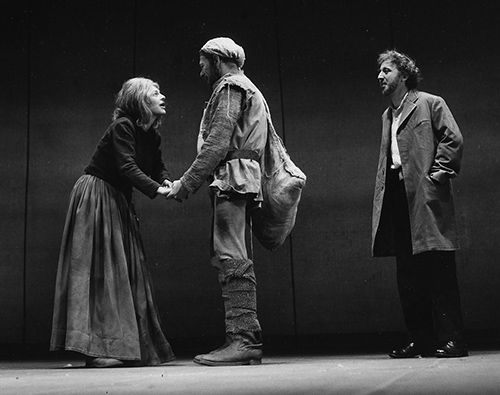
Once upon a time, a young actor had a role in a stage drama. The reviews were good, but the actor felt that he didn’t fit the role. It didn’t match his natural acting style, which was more physical and expressive. He was getting frustrated.
And then, someone came to see the play, Berthold Brecht’s “Mother Courage and Her Children,” on Broadway. (That’s Gene, in the photo, at the right.)
Her name was Anne Bancroft, and she saw in Gene Wilder what he saw in himself and introduced him to her boyfriend (later, husband), director Mel Brooks, who was directing the movie, “The Producers.” Mel asked Wilder to read for the role of Leo Bloom.
The rest is history, as they say. This role led to a cascade of successes: “Blazing Saddles,” “Young Frankenstein,” “Willy Wonka & the Chocolate Factory,” and much more. And let’s not forget Wilder’s marriage to comedy great Gilda Radnor.
Wilder talks about all of this in a documentary that I recently saw. He expressed gratitude and classified these breaks partially as lucky. And he wasn’t wrong. Sure, Wilder was wildly talented. He had a true gift for comedy. But he also positioned himself to be ready for the opportunities that came his way.
This got me thinking about my clients. I find that many people who are unhappy in their careers tend to adopt a cynical attitude. They often express that they believe the system is stacked against them. This leads them to close themselves off from potential opportunities. But none of us can predict the future. To some degree, we must be present in multiple arenas to receive the situations that await us.
We don’t know if and when opportunity will come our way, but, as the saying goes, 80% of success is showing up.
Wilder knew this. Born Jerome Silberman, he was part of a working-class family without show-business connections. His discovery that he could make people laugh was an accident. When he was a boy, his mother’s heart condition worsened and the doctor cautioned him not to upset her; instead, to make her laugh.
This led him to think more about how to use his talents. The way he (and most people who achieve success in entertainment) positioned himself is a lesson to all of us:
✔He honed his craft through rigorous training: We can easily maintain our readiness to accept an opportunity by keeping our skills up to date. There are many ways to do this; many training platforms, including LinkedIn Learning, Coursera, and Udemy.
✔He built a network of influential connections: This is where people fail. Staying active within your profession is vitally important to your career. Join a professional organization. Attend activities in your community—even if they are not about your career. Volunteer. You don’t know who you will meet.
✔He consistently sought opportunities to showcase his unique talents in both theater and film: Find ways that you can present who you are to the world. Your resume is a natural vehicle. So is your LinkedIn profile. But writing, posting your projects, sharing your portfolio, serving on a nonprofit board, stepping up to present at a training event—these are only a few things you can do to share your talents and perhaps attract the attention of someone who has a synergistic opportunity.
Benefiting from luck means putting yourself out there—going places, meeting people, and saying, “Yes!” to something even when you are unsure if it will work. Imagine if either Sergey Brin or Larry Page had felt tired and not joined a prospective student tour of Stanford University. They would not have met and we probably wouldn’t have Google.
Ditto for the day that Howard Schultz, a coffee-maker salesman, stopped into a Seattle coffee shop. He might have been running behind and skipped seeing what this little shop called Starbucks was doing.
I’ve watched (and experienced) this kind of serendipity in careers: reluctant early-morning networkers who met recruiters looking for their unique skills; long-shot interviews that resulted in 11th-hour offers; chance conversations on airplanes that led to interviews; conference events that initially looked dull but proved to be unexpected gateways to discussions with hiring managers.
It happens all the time.
So, next time you’re wondering if saying “yes” to something is worth your time; if you are not feeling like attending an event or talking to a stranger, remember Gene Wilder. He could have declined to audition for the play (in fact, Wilder had almost reconsidered, since it was a small role), and we would have been deprived of the ingenious moment when Dr. Frankenstein (That’s “Frahn-ken-steen!”) danced on stage with the Monster.
Go. Say yes. Do it.
If you aren’t there when your opportunity arrives, you could miss out on something great.
Want to find out more about how you can make some luck? Let’s chat: https://calendly.com/ruthestern/20min
